
My whole life I’ve felt a bit like a weirdo.
Like an onlooker of life, at the edge of the bubble, but never quite inside of it.
I’ve tried finding my way inside, into that bubble, and occasionally, I do succeed.
But not before long, I feel the pull, and drift back to the edge, looking both inside, and outside.
I think I finally figured out why.
*
I feel like I sit in a peculiar place in the Substack space, I’d like to think the algorithm can’t quite make sense of me.
On one hand, I see the neuroscience crew - my former home, my comfort zone.
Next, I seem to gravitate towards the AI & tech crew - maybe because I trained in the field of neuroscience that’s most closely related to AI1 and have a lot of friends in tech. But I’m very much a curious bystander, fascinated by what I can only understand superficially.
Then, of course, there’s the neurodiverse crew that I’ve surrounded myself with my whole life: my fellow weirdos, even though I still don’t feel like I quite fit in either. With the exception maybe of the gifted folks, a world I only recently found out exists.
There’s the yoga & spiritual crowd, whose world I want to learn more of, and whose point of view I’ve only recently started to approach.
Then there are the writers - the ones whose words inspire me, whose way of writing I aspire to. The ones who make me want to create art with science through words of beauty.
*
Have you heard of graph theory?
It’s a concept from maths that’s actually fairly easily intuited2.
Take a look at this little illustration that yours-truly hand-crafted on Canva:
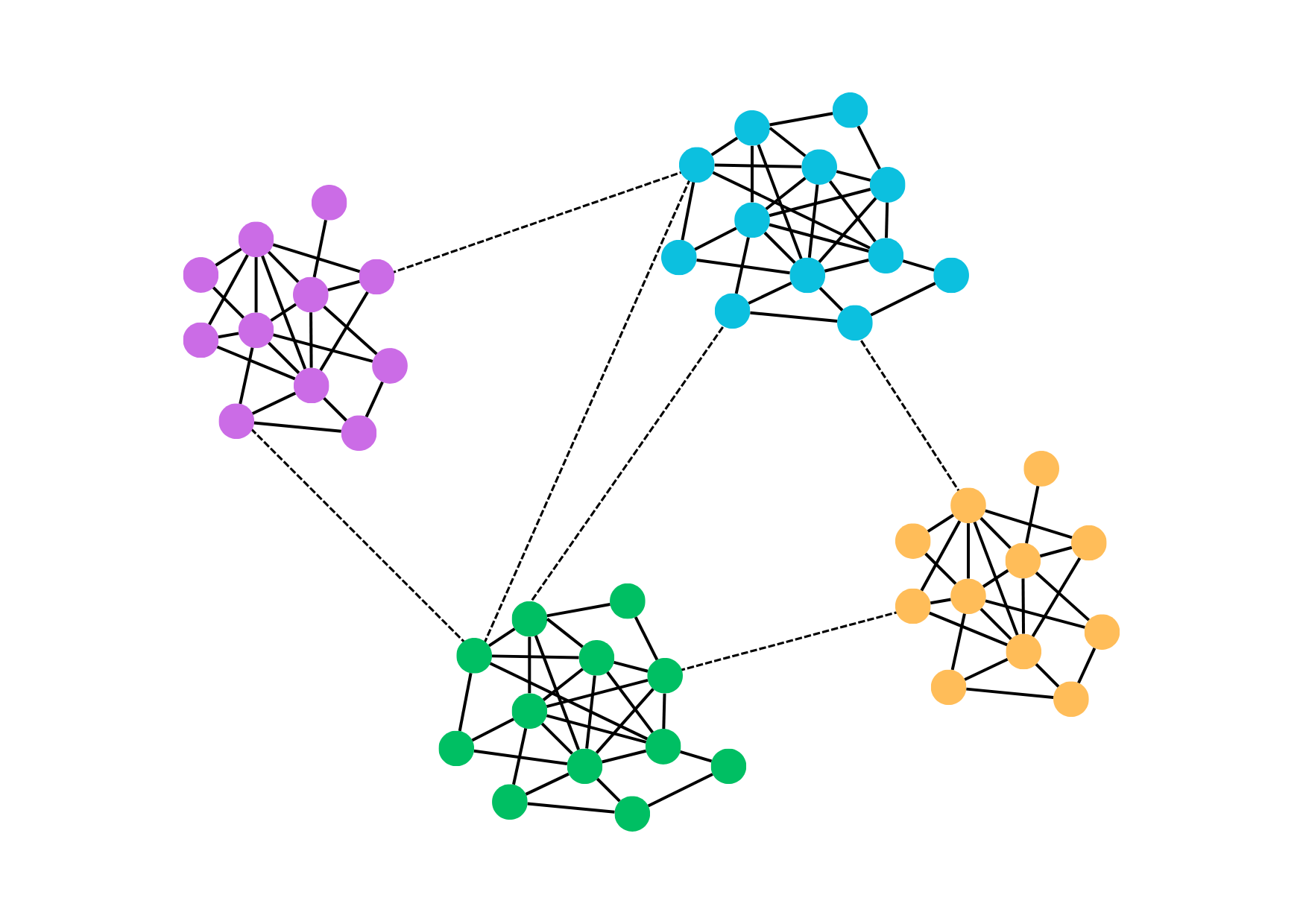
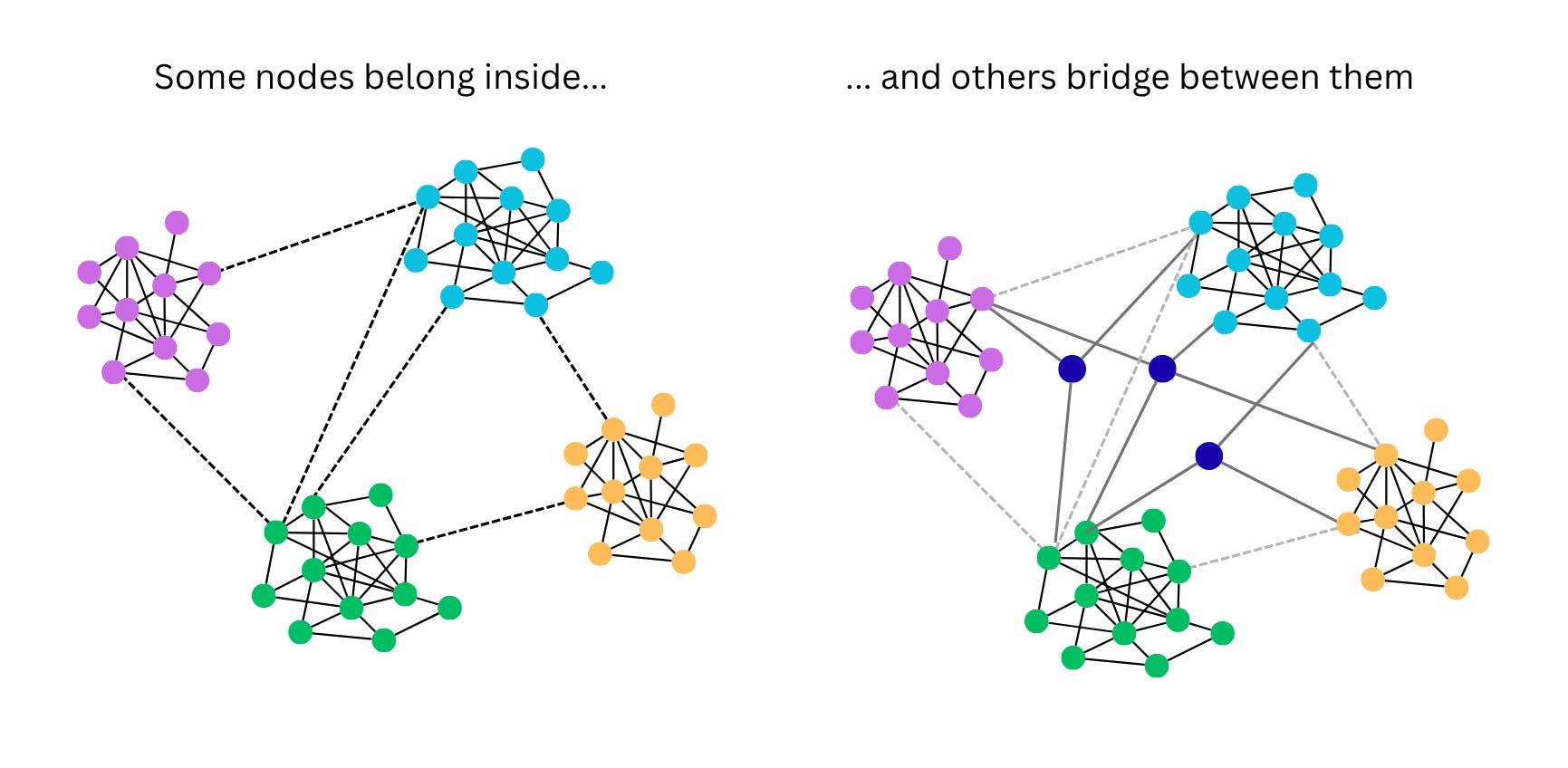
See how the different dots each form their own cluster? And how the dots that are within a cluster tend to be connected to each other, some are in the middle and have lots and lots of connections to all the other dots, others have fewer but still primarily have connections within the cluster, and then some dots have connections to a dot from a cluster with a different colour?
In graph theory, each dot is called a node, and the connections between the nodes (the dots) are called edges, and it turns out you can do some pretty neat math when you start quantifying them and reveal some hidden structure within a network - be that a social network, or a neural one.
But I’m not a mathematician, and I digress.
The network I crudely illustrated above is only one example of a particular kind of network; there are many many more different kinds that graph theory can describe - if you’re curious, do a little image search for graph theory and you’ll see what I mean.
There is another type of node though that I didn’t include in the first illustration, but that I’m exemplifying here in the modified illustration below:
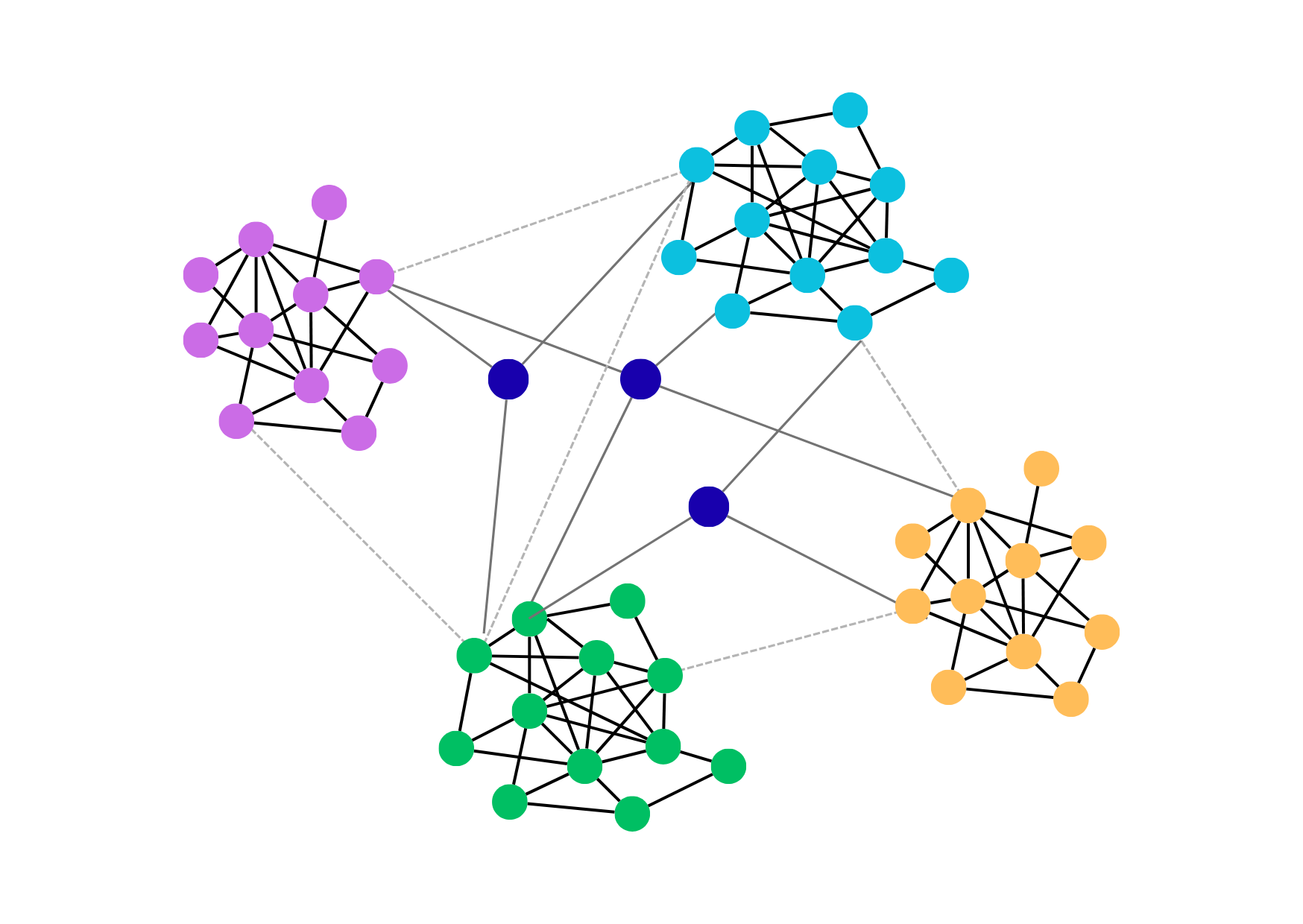
Can you see yet where I’m going with this?
I’m one of those dark blue dots.
A bridge node is what they’re called; they’re nodes in between clusters that create connections - bridges - between them.
*
I love science. So much so that I can’t help but think of a mathematical concept to describe the existential angst I’m feeling from not knowing how to make myself turn into one of those central nodes - the ones with lots of connections with dots of the same colour, the ones that have no doubt which cluster they belong to.
But maybe I don’t need to.
There is something else I’ve noticed.
Science requires minute attention to detail for the problem that you’re trying to solve. And while I am naturally prone to notice details, this extends to details that others don’t notice - or even think are relevant. As a result, I find myself constantly pulled in many directions, trying to bring all the details together under one and the same roof, and in the process coming up with a scientific agenda that would take decades if not centuries to implement.
I’m not so good at deciding which details are the ones that matter most - to me they all matter. But you can’t pay attention to all of them at once.
And you know what I’ve been pondering? I think I share this trait with writers.
I’m not the first one to notice that often times, writers are keen observers. We take what we see around us, and somehow, obsessively, compulsively, try to make sense of it by putting it into words.
As a writer, you have artistic license - you can take a birds-eye view and let the details all be there but melt into the background. As a scientist, if you do that, you’ll have reviewers banging on about how you’re not describing the problem rigorously enough, each one banging on about the detail that just so happens to be their favourite one.
I used to dream of being a PI - a principle investigator, the kind of scientist who heads their own lab, with multiple people working on multiple interrelated projects. I thought that’s how I could finally get to look at all the different details I see that I can’t possibly tackle all by myself.
But as you probably know by now, life had different plans for me.
So here I am, a writer instead.
And you know what I’ve begun to notice?
I feel at home with writers in a way I never have before.
It’s the same thing I was circling in my “Ever had an existential crisis on your way to work? Yeah me too” piece - you know what “work” was that day? The London Book Fair. I think I’ve found the next piece of the puzzle why I felt so drawn to that place - I wasn’t just surrounded by books, I was surrounded by writers.
I think it’s why I love Substack so much. Even though I can still see how most clusters primarily connect between the nodes within, I’m also seeing more blue dots like me. Those of us who are a little adrift, don’t quite neatly fit in anywhere, but yet I feel a kinship amongst our diffuse little in-between cluster existence, for there is one thing we all have in common: we are bridges between worlds.
Calling myself a writer still has that sting of imposter syndrome every time I say it.
But I’ve gotten through imposter syndrome before, and I’m sure I will again. By continuing to show up anyway.
***
Everything in my Science, yoga, and the world in between publication is free.
If you’d like to show some support, you can sponsor my caffeination below - and in the process, help keep my migraines at bay (yes, coffee helps me).
I feel so scene in this story. I am a blue dot. I have tried my whole life to be part of one of those groups, but never quite fit in. I want to feel accepted and liked, but really I am the blue dot. The person who thinks outside the box, feels too much, and then pulls people together to do cool things.
Hello blue dot 👋